

When someone asks me which heatless curler to buy, my first question is not about price. It is: what do you want your hair to look like in the morning? A soft wave, a defined curl and a bouncy blowout are different styling goals. The tool that fits one may disappoint with another.
I am Sabine Kaleja, founder of Kaleja Silks. I developed our silk-covered curlers because I wanted a heat-free routine I could actually use, including overnight. My own hair is long, thick and naturally straight, and I usually use our Classic on dry hair. Below I compare seven types of heatless curling tools and methods, including options we do not sell. This is a buying guide, not a laboratory ranking.
At a glance: seven heatless curler types
| Type | Usually creates | Sleeping in it | Main trade-off |
|---|---|---|---|
| Silk-covered standard rod, about 2.5 cm | Defined curls | Often comfortable when soft and positioned well | Requires practice with wrapping |
| Large silk-covered rod, about 4 cm | Loose waves and volume | Depends on your sleeping position | Short layers may slip |
| Four smaller silk-covered rods | Airy, directional blowout movement | Comfort varies with placement | More sections to wrap |
| Soft foam rollers | Smaller or medium curls | Some designs work for sleep | Several pressure points |
| Flexible foam rods | Spiral or tighter curls | Variable | Ends can press or tangle |
| Velcro rollers | Root lift and rounded ends | Better for daytime | Can catch fragile hair |
| Socks or a robe belt | Variable waves | Depends on fabric and knot | Inconsistent size and hold |
I would compare finished results, secure attachment, outer fabric and your patience, not promise one tool works for everybody.
1. Silk-covered standard rod: my versatile first choice
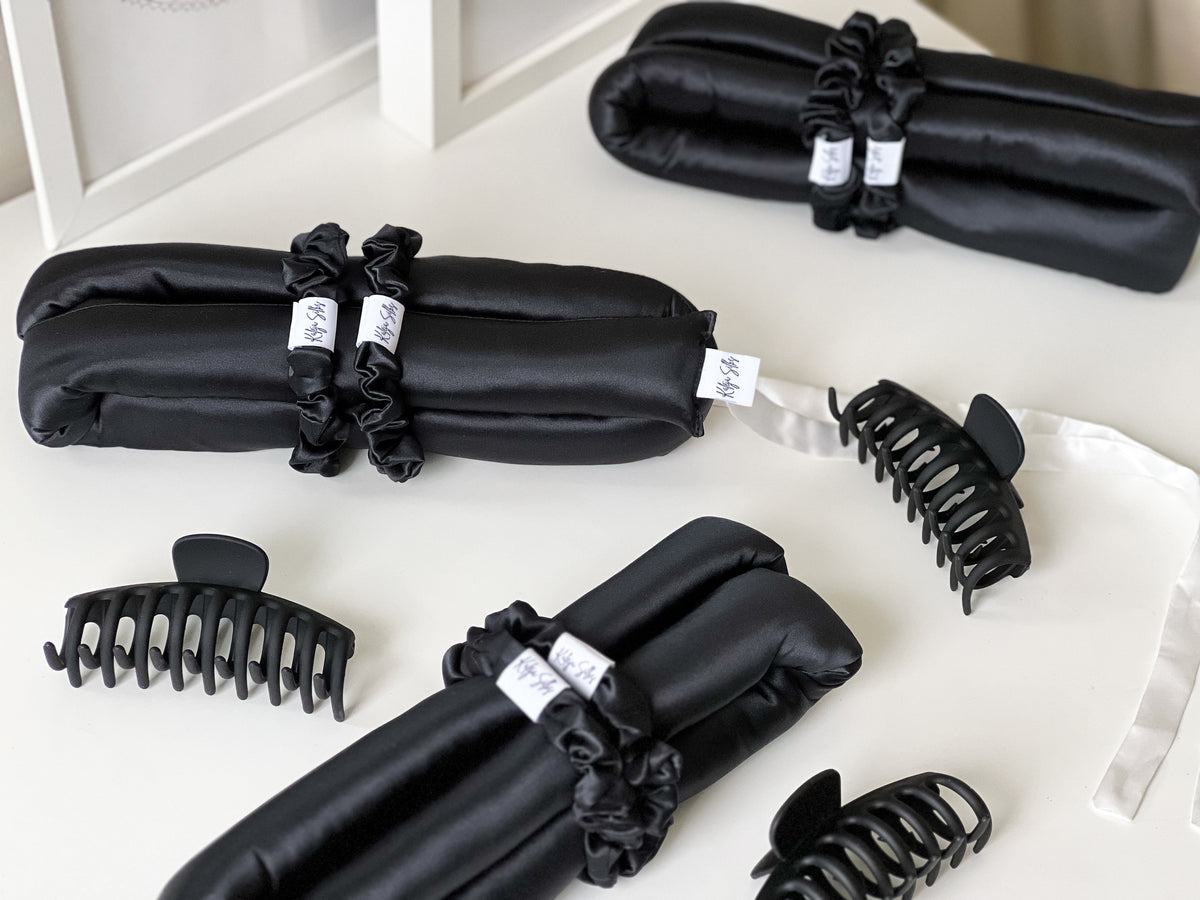
A single padded rod runs across the head while you wrap hair around it. A smaller diameter generally makes a tighter bend than a larger one, but section size also matters. Our Kaleja Silks Classic has a 2.5 cm diameter and a 100% Mulberry silk outer surface. I like how smaller sections give me a more defined result and larger sections soften it.
Best for: shoulder-length to long hair, people who want an adjustable curl and a repeatable overnight routine. Consider another option if your hair is shorter than shoulder length or if you dislike learning a wrapping technique.
2. Large silk-covered rod: softer movement for longer hair
A broad padded rod places the hair around a larger curve. That usually gives a more relaxed result, especially when hair is sufficiently long to wrap securely. Our Large silk heatless curler measures 4 cm. It is my pick when the aim is movement and volume rather than the most defined curls.
Best for: medium-to-long and long hair, loose waves and fuller-looking lengths. Trade-off: a larger diameter can be more noticeable when you lie on your side; shorter face-framing layers may need more careful placement.
3. Four smaller rods: for the blowout look
Four separate rods divide hair into zones instead of drawing the entire style around one long rod. Our Blowout set has four 2.5 cm rods, each about 25 cm long. Each section can be wrapped in a different direction to create bouncy, salon-inspired movement.
Best for: people who want an airy, multi-directional look, or have layers that are easier to manage in sections. Trade-off: four pieces take more placement decisions, and not every sleeper prefers multiple contact points. The result is not identical to a professional blow-dry.
4. Soft foam rollers: a budget-friendly experiment
Traditional foam rollers come in multiple sizes. They can create a wide range of curls and are often accessible in price. However, rollers sit in several locations around the scalp, so comfort depends on the foam density, closures and where you rest your head.
Best for: testing curl sizes before investing in a preferred routine. Trade-off: inconsistent tension across the head and possible pressure from clips or plastic frames.
5. Flexible foam rods: for spirals and smaller sections
Bendable rods let you wrap individual strands, then fold the ends to hold the curl. They work well when a defined spiral is more important than a quick two-sided wrap. I would use manageable sections and avoid pulling tightly at the roots.
Best for: defined curls and experimenting with different curl directions. Trade-off: they can take time to put in and remove, and may not feel pleasant against the pillow.
6. Velcro rollers: best used while awake
These are primarily for volume, smoothness and lifted roots rather than sleeping. They can work well after a gentle styling routine, provided the hair is removed carefully. The hook-like surface may catch or pull hair, especially if strands are fragile or tangled.
Best for: daytime root volume and rounded ends. Trade-off: I would not choose them as my first overnight option.
7. Socks and robe belts: inexpensive but less predictable
A soft household fabric can hold hair in a curved shape without heat. It is a reasonable experiment before buying a tool. Fabric width, seams, knot placement and slipperiness vary, however, so results are harder to repeat. A belt made from a rough material may also create more snagging than a smooth, purpose-made covering.
Best for: seeing whether you enjoy the idea of heatless curls. Trade-off: lack of consistent diameter, secure fastening and designed-for-sleep padding.
Why I prefer reducing curling-iron heat
Frequent or excessive heat can damage hair fibres. Dermatologists at the American Academy of Dermatology recommend limiting high-temperature styling and keeping curling-iron contact brief. A published curling-iron microscopy study found damage to hair surfaces after thermal treatment, especially under certain wet-hair conditions.
This does not mean using a curling iron once destroys your hair. Risk changes with temperature, frequency, moisture, repeated passes and hair condition. Heat protectants can be useful, but they do not make extreme heat harmless. Heatless styling removes the hot barrel from the routine, which is the main reason I like it. It does not remove the need to avoid painful tension or to let damp hair dry thoroughly.
How I would choose between Classic, Large and Blowout
| What you want | My Kaleja Silks recommendation | Why |
|---|---|---|
| A defined curl, adaptable with section size | Classic | 2.5 cm single padded rod |
| Loose, fuller waves on longer hair | Large | 4 cm broad curve |
| Airy, separated blowout movement | Blowout | Four independently wrapped zones |
| Hair shorter than the shoulders | Test small rollers first | Our products are specified from shoulder length |
| Only occasional quick daytime styling | Foam or Velcro may suffice | No need to pay for an overnight system you will not use |
My buying verdict: for a person who wants one premium heatless curler to learn and use often, I would start with Classic. I would choose Large for a looser finish and Blowout for that specific multi-zone look. Their 100% Mulberry silk covering, considered padding and secure tying system make them attractive when daily usability matters. Compare all three in the heatless curler collection.
Questions I would answer before checkout
Which heatless curler is best for beginners?
A soft single rod is a practical starting point for many people. Expect a short learning curve, and do not wrap so tightly that it pulls at the scalp.
Are heatless curlers better than curling irons for hair?
They avoid direct high-temperature contact. That can reduce one source of styling stress, but rough wrapping and too much tension can still damage strands.
Can I use a heatless curler on wet hair?
I would use dry or only slightly damp hair and make sure it is fully dry before removal. I usually choose dry hair myself.
Will any heatless curler work on very short hair?
Not necessarily. Length must be sufficient to wrap and secure the section. A short cut may suit small rollers better than a long padded rod.
For positioning and sleep comfort, I have a separate guide to sleeping with a heatless curler. That article covers the technique; this one helps you decide what to buy.
Share:
6 Heatless Curlers for Sleeping: Which Design Feels Best?
Silk vs Bamboo Pillowcase: Which Is Better for Hair and Skin?