

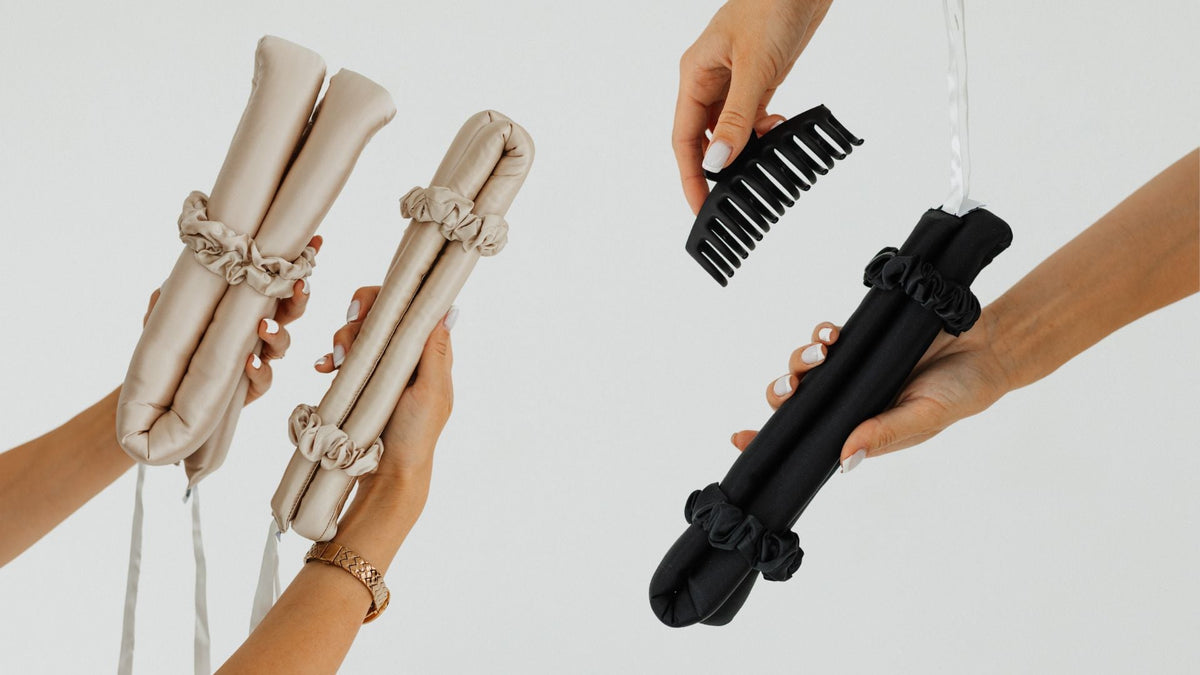
What is the difference between a silk and satin heatless curler? The first thing I would clarify is that silk and satin are not exact opposites. Silk is a fibre, while satin describes a weave. A satin curler is often made from synthetic fibres unless the product specifically states otherwise. For me, this distinction became important before Kaleja Silks even had its first customers.
My first handmade heatless curler was actually satin. I had discovered the robe-belt curl method online, loved the principle and disliked the rougher feel and sleeping comfort of a robe belt. I sewed a soft, filled alternative myself using my mother's sewing machine. After researching materials more deeply, I moved from satin to silk, and that decision became part of the foundation of Kaleja Silks.
Silk vs satin: fibre and weave are different things
Silk is a natural protein fibre. Satin is a weaving structure that creates a smooth, glossy surface and can be produced from different fibres, including polyester or silk.
That means the label "satin heatless curler" does not tell you the fibre content by itself. If material matters to you, check the composition rather than relying only on the surface appearance.
Why does the outer material matter on a heatless curler?
Your hair stays in contact with the curler for several hours, often overnight. I therefore care about how the surface feels while hair is being wrapped, held in place and unwrapped.
A smooth surface can reduce unnecessary rubbing compared with a rougher fabric. I also prefer the feel of silk when removing the curler because the hair can slide away more smoothly instead of catching against a coarse surface.
I would not claim that silk magically repairs hair or guarantees that no strand will ever break. A heatless curler is a styling tool, not a medical or restorative treatment. Technique, tension and the condition of your hair still matter.
Why I changed our first curler from satin to silk
The origin of Kaleja Silks starts with an experiment. I saw people making curls with the belt from a bathrobe. At the time, the idea felt almost completely new in Latvia. I tried it and realised immediately that the principle worked, but I did not like the experience: the robe material made my hair feel frizzier and the belt was uncomfortable to sleep on.
So I made a padded curler. The first version was satin because I was solving the shape and comfort problem first. Then I started researching the material itself. That led me to silk.
I sewed the first prototypes myself on a sewing machine borrowed from my mother. When I unwrapped one of those early curlers in the morning, I was so happy with the result that I was literally jumping around the house. That was the moment I knew the idea was too good to keep only for myself.
Why 22 momme Mulberry silk?
All three current Kaleja Silks heatless curler models use 22 momme 100% Mulberry silk on the outer surface. Momme is a traditional measure used to describe the weight and density of silk fabric. A higher momme number generally means more silk material is used per area of fabric.
For a reusable product that is wrapped around hair and handled frequently, I want the surface to feel substantial as well as smooth. That is why material specification is something I prefer to state clearly rather than simply writing "silky".
Does a silk heatless curler create better curls than satin?
The curl shape itself depends strongly on the physical design of the curler and how you use it. Diameter, filling, section size, wrapping tension, moisture and setting time all matter.
I would not say that changing the fabric alone turns a poor technique into perfect curls. My reason for choosing silk is the combination of a smooth contact surface and the overall product experience, while the rod design determines much of the curl geometry.
Is a silk heatless curler less frizzy?
A smoother surface can mean less rubbing during the hours your hair is wrapped, which can help the finished style look smoother for some people. But frizz has many causes, including humidity, hair condition, products and how you separate the curls.
I prefer to describe silk as one useful part of the routine rather than promise a guaranteed frizz-free result.
Does the filling matter too?
Absolutely. My original problem with the bathrobe belt was not only the fabric. I also wanted something softer and more comfortable to sleep on. That is why the idea evolved into a filled rod rather than simply replacing the robe belt with another strip of fabric.
Comfort is especially important if you plan to keep a heatless curler in overnight. A beautiful material does not help much if the shape is too hard or awkward for your sleeping position.
What should you check before buying a silk heatless curler?
- Does the product clearly state the fibre composition?
- Does it specify real silk rather than only using words such as "silky"?
- Is the silk weight, such as momme, provided?
- What is the rod diameter and what curl shape is it designed for?
- Is the filling soft enough for your intended routine?
- How is the curler secured so it stays in place?
- Which hair lengths is the model designed to accommodate?
For Kaleja Silks, you can compare the Classic, Large and Blowout designs in our silk heatless hair curler collection.
Frequently asked questions about silk vs satin heatless curlers
Is satin the same as silk?
No. Silk is a fibre. Satin is a weave and can be made from different fibres. Many satin beauty products are synthetic, so always check the material composition.
Are Kaleja Silks heatless curlers made from real silk?
Yes. The current Classic, Large and Blowout models use 22 momme 100% Mulberry silk on the outer surface.
Does silk make heatless curls last longer?
Curl longevity depends more directly on your hair, wrapping technique, section size, setting time, moisture and styling products. I choose silk primarily for the smooth contact surface and product experience.
Can satin heatless curlers still work?
Yes. My own first prototype was satin and the curling principle worked. I later chose silk after researching materials and thinking more deeply about the surface that would stay in contact with hair for hours.
Is silk the only thing that matters in a heatless curler?
No. The rod diameter, filling, construction, securing method and your technique are all important. Material is one part of a complete design.
Share:
Silk vs Satin: What Is the Difference?
How to Tell if Silk Is Real: 8 Checks Before You Buy