



How to tell if silk is real is a much better question than "does it look silky?" Polyester satin can be very smooth and glossy, so appearance alone is not enough. The most reliable first check is the stated fibre composition.
When I compare silk products for Kaleja Silks, I prefer evidence that can be checked before purchase: composition, specifications, construction, seller transparency and care information. I would not ask a customer to burn, damage or pull apart a product just to prove what it is.
How can you tell if silk is real?
Short answer: start with the label or product composition. A genuine silk product should clearly state silk as the fibre, ideally with a percentage such as 100% silk. Then use the other checks below to see whether the rest of the product information is consistent.
1. Check the fibre composition
Look for wording such as 100% silk or 100% Mulberry silk. Be careful with vague terms such as "silky", "silk touch", "satin" or "silk feel". Those phrases describe appearance or feel, not necessarily fibre content.
2. Understand what Mulberry silk means
Mulberry silk is a type of silk commonly used in premium bedding and accessories. The term is useful when paired with an explicit fibre composition. A good product page should not rely on "Mulberry" as a luxury word while hiding the actual material percentage.
3. Look for momme on silk bedding
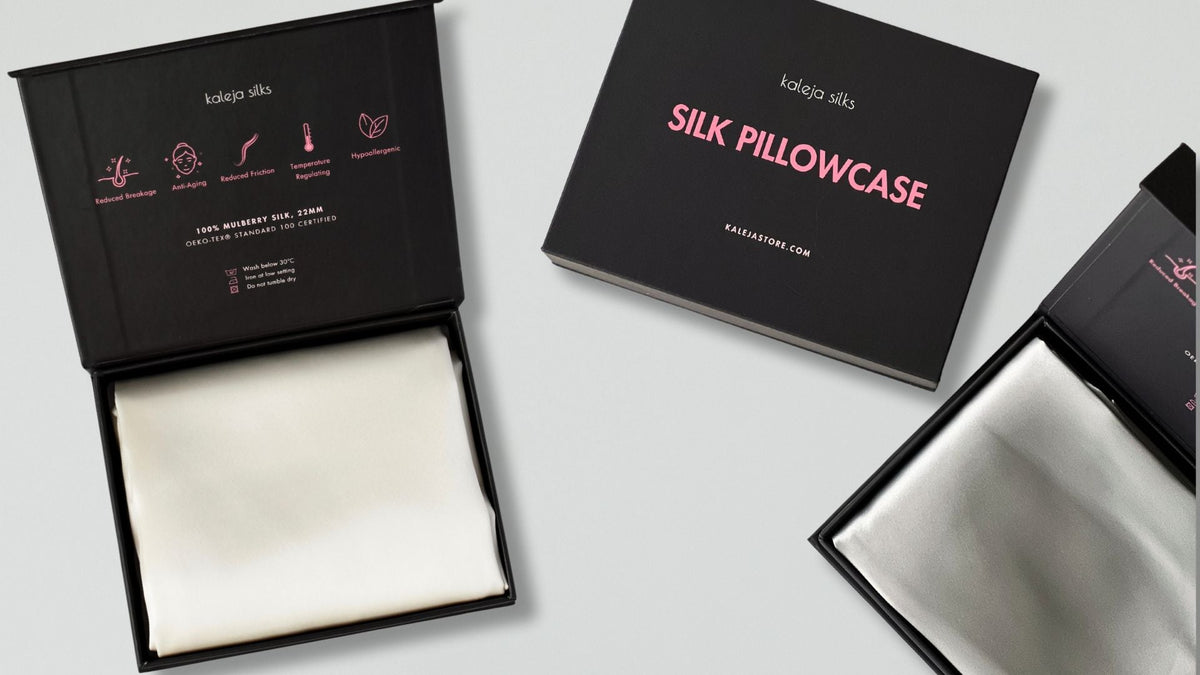
Momme is commonly used to describe silk fabric weight and density. It is particularly useful when comparing silk pillowcases. At Kaleja Silks, our Mulberry silk pillowcase is specified as 22 momme.
Momme does not prove fibre composition on its own. A seller should still clearly state that the product is silk.
4. Compare the price with the specification, not only competitors
A very low price does not automatically prove that a product is fake, and a high price does not prove that it is real. Price should make sense together with fibre content, fabric weight, size, construction, packaging, quality control and seller policies.
5. Check whether the product description is internally consistent
Look at the title, material section, care instructions and FAQ. If one section says "100% silk" and another says polyester, that is a clear warning sign. If the seller cannot tell you the fibre composition, I would not treat the product as verified silk.
6. Look at the construction
For a pillowcase, check seams, zipper or envelope closure, dimensions and finishing. For a scrunchie or hair curler, check the elastic, stitching, shape and which parts are actually made from silk. A real silk outer fabric does not automatically mean every component of an accessory is silk.
7. Read the care instructions
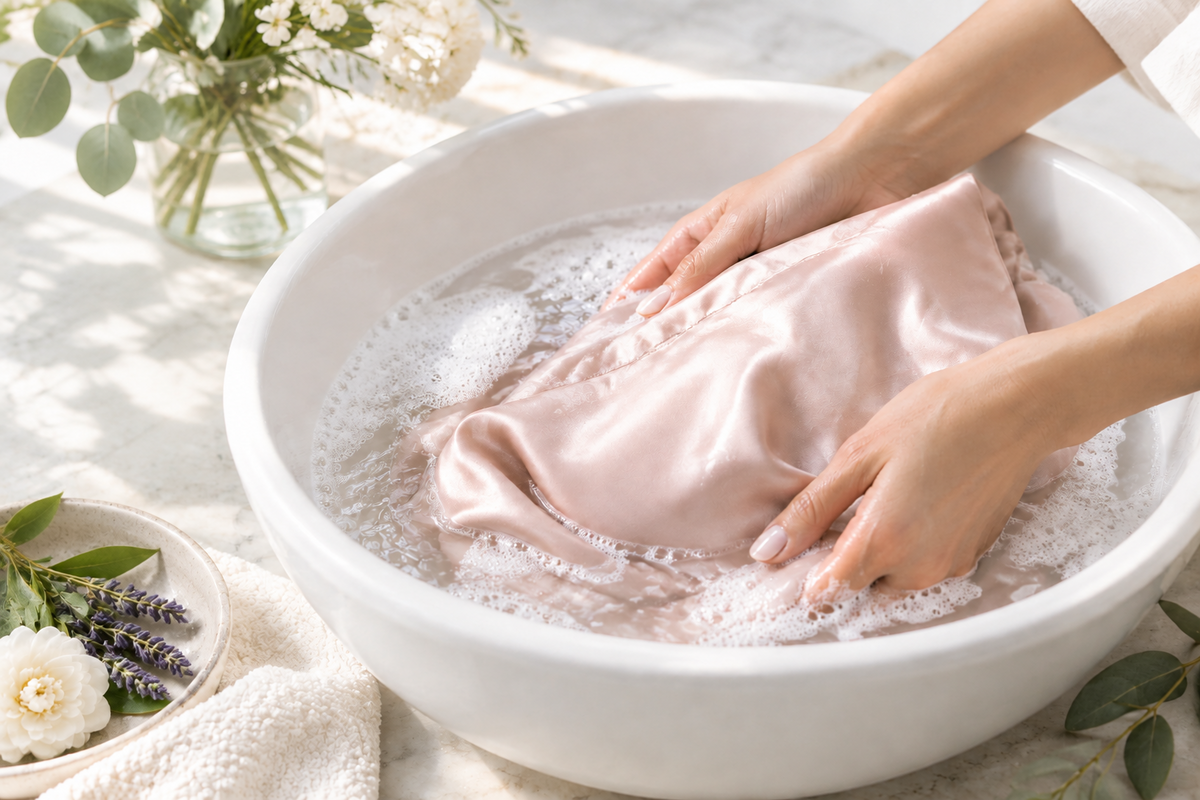
Silk is a delicate protein fibre. Care guidance should reflect that. Instructions usually prioritize gentle washing, low mechanical stress, appropriate detergent and avoiding damaging heat or chlorine bleach. Always follow the care label on the specific item.
8. Check who is selling it
A trustworthy online store should make it easy to find company details, contact information, returns, delivery terms and customer reviews. This does not identify fibre under a microscope, but it makes misleading product claims less difficult to challenge.
What about the burn test for silk?
You may see the "silk burn test" recommended online. I do not recommend damaging a finished product or using an open flame as a routine buying test. Fibre identification can be done professionally, while consumers can make a much safer first assessment using labelling and seller documentation.
Can you identify real silk by touch?
Experienced textile professionals may notice differences in hand feel, drape and lustre, but touch is subjective. Modern synthetic fabrics can imitate many visual and tactile qualities of silk. Treat touch as supporting information, not proof.
Questions people ask about real silk
Does real silk always shine?
No. Silk can have lustre, but the amount of shine depends on weave, finish, colour and lighting. A very shiny surface is not proof of silk.
Is satin fake silk?
No. Satin is a weave, not a fibre. Satin can be made from real silk or from synthetic fibres such as polyester.
Is 22 momme real silk?
22 momme is a fabric-weight specification used for silk. You still need to check the fibre composition. A complete product description might state "100% Mulberry silk, 22 momme".
Can a product contain only some silk?
Yes. Textile products can be blends. The label should state the fibre percentages where required. Do not assume that the word "silk" in a product name means 100% silk.
What is the safest way to buy silk online?
Choose a seller that clearly states fibre content, relevant specifications, care instructions, company information and return terms. Keep the product description or order confirmation if you need to compare what was promised with what you received.
My checklist before I call a product "silk"
I want the claim to be specific enough that a customer can understand it without guessing. For a silk pillowcase, for example, "100% Mulberry silk, 22 momme" is far more useful than "luxury satin".
Share:
Silk vs Satin Heatless Curlers: What Does the Material Actually Change?
Silk Gift Guide: Gift Ideas for Her at Every Budget